
|
[i] Information | ||||||||||||||||||
|
|
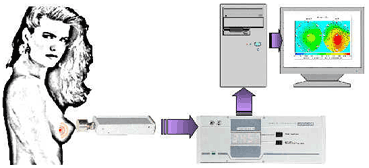
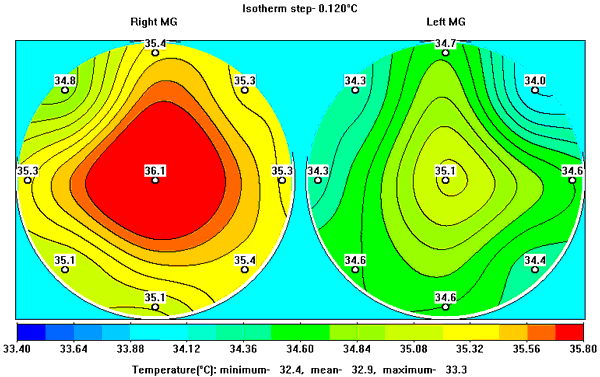
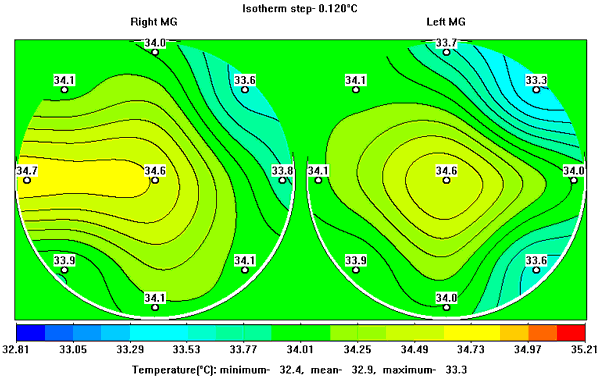
Microwave RadiometryMicrowave Radiometry is based on measuring the intensity of natural electromagnetic radiation from a patient's tissue at microwave frequencies. This intensity is proportional to the temperature of tissue. The change in temperature (thermal abnormality), that is a basis of earlier detection of breast cancer, may be caused by increased cancer cell metabolism. It should be noted that thermal changes precede to the anatomical changes that can be detected by traditional methods such as ultrasound, mammography and palpation. Thus microwave radiometry is a very promising method for the breast cancer detection at an earlier stage. Basis of Microwave RadiometryMicrowave Radiometry is based on measuring the intensity of natural electromagnetic radiation from a patient's tissue at microwave frequencies. This intensity is proportional to the temperature of tissue. So we can say that microwave radiometry allows one to measure the internal temperature and display it on the monitor.
Difference between Microwave Radiometry and Infrared Thermography The main difference between well known infrared thermography and microwave radiometry is that the former allows to read and display the skin temperature, when the latter indicates the internal temperature. Advantages of Microwave Radiometry 1. Non-hazardous Microwave Radiometry is non-hazardous both to the patients and to the personnel taking the thermograms, as during the examination the intensity of natural electromagnetic radiation from the patient's tissue is measured. 2. Non-invasive Temperature is measured non-invasively. 3. Earlier detection of diseases Thermal changes precede to the anatomical changes that can be detected by traditional methods such as ultrasound, mammography and palpation. Thus microwave radiometry is a very promising method for the breast cancer detection at an earlier stage. 4. Detection of fast growing tumors The specific heat generation in the tumor is proportional to the grow rate of the tumor. So fast growing tumors are "hotter" and they are more contrast in thermograms. Thus microwave radiometry is an unique method that allows to detect first of all fast growing tumors. Using microwave radiometry (RTM-Diagnosis) in conjunction with other tradition methods allows to select patients with fast growing tumors. 5. Ability to detect patients with increased proliferative activity of cells The important feature of the microwave radiometry is that it can distinguish proliferative mastopathy and fibroadenoma from non-proliferative mastopathy and fibroadenoma. So the method allows to select patients who risk to have breast cancer. 6. Ability to monitor treatment Microwave Radiometry is non-hazardous both to the patients and to the personnel taking the thermograms, so it can be effectively used for the monitoring of the treatment.
|
|
|||||||||||||||||
|
|||||||||||||||||||

 News
News
